
Why Water Operators Earn $27K Less Than Electric Workers (And How Digital Skills Close the Gap)
Water utility digital transformation requires trained operators, not just tech. Learn how upskilling teams solve the $1.25T funding gap and wage crisis.

Digital tools are now essential to address aged and failing infrastructure. Our water systems are old and starting to fail in pockets around the country but are accelerating in their failure each year as we underinvest in our infrastructure. Current projections are a funding gap of $1.25 trillion over 20 years or $62.5 BILLION a year. The only way to overcome this funding gap is with a combined PHYSICAL and DIGITAL approach.
By 2030, nearly one-third of the water utility workforce is expected to retire, threatening the stability of our water systems. At the same time, digital technologies like AI, IoT, and real-time analytics are transforming how utilities operate. Often with the promise of greater efficiency and resilience. But technology alone isn’t enough, people are the heart of this transformation.
To use a combined physical and digital approach, utilities must bridge a skills gap so that operators can leverage new technologies effectively. The success of this transition depends on investing in the people who run these systems. When we support our people, our people support our water systems.
The answer isn’t just throwing money at the problem. It’s water utility digital transformation, but only if we put people first.
The Real Crisis: It’s Not Just Aging Infrastructure
The aging workforce is a pressing issue, with one-third of water utility workers eligible to retire within the next decade (2024 U.S. EPA Water Workforce Report).
At the same time, water utility digital transformation is accelerating. AI-powered analytics, IoT sensors, real-time monitoring, and predictive maintenance are no longer future concepts, they’re operational necessities for utilities trying to do more with less. So, there is the additional issue that digital systems require new training and changes at the daily operations level. This coupled with the lower wages of the water industry are posing another challenge. Lower wages are making it difficult to attract the best technical talent into the water industry vs electric or other utilities.
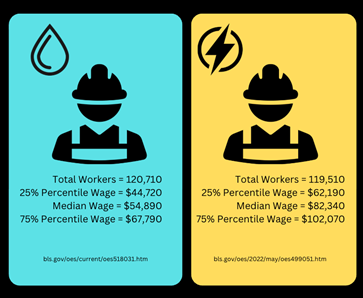
The average water operator makes $54,890 while a similar skill set on the electric utility side makes $82,340. Why is this?
Why the Water Industry Lags in Digital Adoption
There are many drivers but one of those is the lack of digital engagement and upskilling in the water industry. The operator of yesterday is not the same as the operator of tomorrow. The person may be the same, but their jobs will be completely different.
Water utility digital transformation introduces legitimate complexities, requiring operators to master skills like interpreting real-time data and managing predictive analytics, which can be a challenge for those accustomed to traditional methods. This is especially true in the water industry where systems are complex, so field experience is a requirement to understand the impacts of valve changes or pumping adjustments. Resistance to change is common, particularly if digital initiatives are implemented too quickly without adequate support.

The Operator of Tomorrow Looks Completely Different
Successful water utility digital transformation doesn’t eliminate operators, it elevates them. Consider these fundamental shifts:
Flushing Operations: Instead of manually flushing 100 hydrants a month at 15 minutes each at 250 gpm, they will check their sensors, and AI will recommend the 10 critical hydrants to flow and exactly for how long and what flow rates.
Leak Detection: Instead of spending months and months manually searching for leaks and breaks they will maintain the fleet of acoustic leak sensors. When a leak happens, they will be notified of the location, severity, and how to prioritize that with all their other issues.
Treatment Plant Operations: Instead of manually watching the treatment plant incoming flows and quality. They will set up a sensor and software network to track water quality and flows upstream and predict hours and days in advance the exact flow and quality they will be getting. Then adjust their pumps and chemical treatment just in time.
Sewer Overflow Prevention: Instead of manually cleaning up sewer overflows, they will tie their lift station data together with sensors and AI software to predict overflows up to 6 hours in advance. They can go clean the fats, oils, and grease blockages at just the right time before the storm rolls in so there is never an overflow to begin with.
Meter Reading: Instead of manually reading meters, they will deploy automated meters networks (AMI). Then spend their time on meter and radio maintenance checking for signal strength and failing equipment.
The pattern is clear: Water utility digital transformation replaces repetitive manual tasks with strategic, analytical work requiring higher-level skills, work that commands higher wages.
Human-Centric Digital Transformation: Infrasync’s 3D Approach
So how do you move forward with digital technology while keeping humans at the forefront?
It all comes down to how the new technology is implemented. If you are always chasing the latest in technology without a people first approach, then you risk digital burnout in your team. On the other side people are most comfortable with the status quo so they may resist new technology even if it makes their jobs easier. To address these challenges, utilities must prioritize training and a human-centric approach.
Infrasync’s proven approach to water utility digital transformation follows three critical phases:

Daylight – Independent analysis and evaluation of the opportunity, steps, costs, and payback.
Design – Technology selections, design, deployments, internal dashboards, staff training, field testing, automations, and data integrations.
Deploy – Operate integrations, automations, ongoing training, internal dashboards, and results tracking. This phase ensures water utility digital transformation delivers promised benefits while adapting to real-world operational feedback.
This must be co-created with engineering technology experts who have deep experience with the sensor, software, piping networks, and treatment plants. They will design and bring in the best outside technology and resources to help. However, the utility must lead the design and deployment as they know their system better than a contractor ever will. They will select the areas of the system and provide the judgement for what systems are the most critical to automate vs can be deferred until later.
The Technology Is Ready. Are Your People?
Water utility digital transformation succeeds when it augments human expertise rather than replacing it. The most effective utilities combine decades of operational knowledge with cutting-edge technology, creating hybrid systems where experienced judgment guides automated processes.
Here is the kicker, the technology is ready, it’s us humans who are behind.
Your Next Steps
Successful water utility digital transformation starts with honest assessment: Where is your utility today? What skills does your team possess? What gaps need addressing before technology deployment?
What steps have you taken to prepare your utility and team for the digital future?
The $1.25 trillion funding gap won’t close itself. The wage disparity won’t fix itself. The workforce crisis won’t resolve itself. But with strategic water utility digital transformation that puts people first, your utility can transform challenges into competitive advantages, for your systems, your team, and your community.
At Infrasync, we believe that empowering your workforce is the key to unlocking the full potential of smart water systems. Our proven process, backed by successful projects across the county, includes tailored programs so that your operators thrive in the digital age. Request an assessment today to discover how your utility can build a resilient, human-centered but digital augmented future.
Learn More Now - Knowledge is Power, get in touch with a Smart Utility Engineer for an Assessment


2 Year Reflection and Restoring our Water Capacity
2 Year Reflection and Restoring our Water Capacity I started InfraSync Technology Services 2 years ago in January 2024. Since then we have completed over

Your Utility Data Isn’t Missing, It’s Being Held Hostage (And How to Take It Back)
Your Utility Data Isn’t Missing, It’s Being Held Hostage (And How to Take It Back) Stop paying ransom for data you already own. Here’s how