Every retail utility with more than 3,300 connections (or any TWDB financial obligation) files a water loss audit every year. Every utility files at least every 5 years.
TWDB: “A utility applying for financial assistance will be required to have its most current water loss audit validated prior to consideration of a request for financial assistance from the Board.”
Real loss over 30 gal/connection/day (57 for rural density) or excess apparent loss means part of any TWDB award must be spent on water loss mitigation.
A validated water loss audit & program to reduce water loss is now required. Mark Mathis (InfraSync) is a nationally certified Water Loss Audit Validator
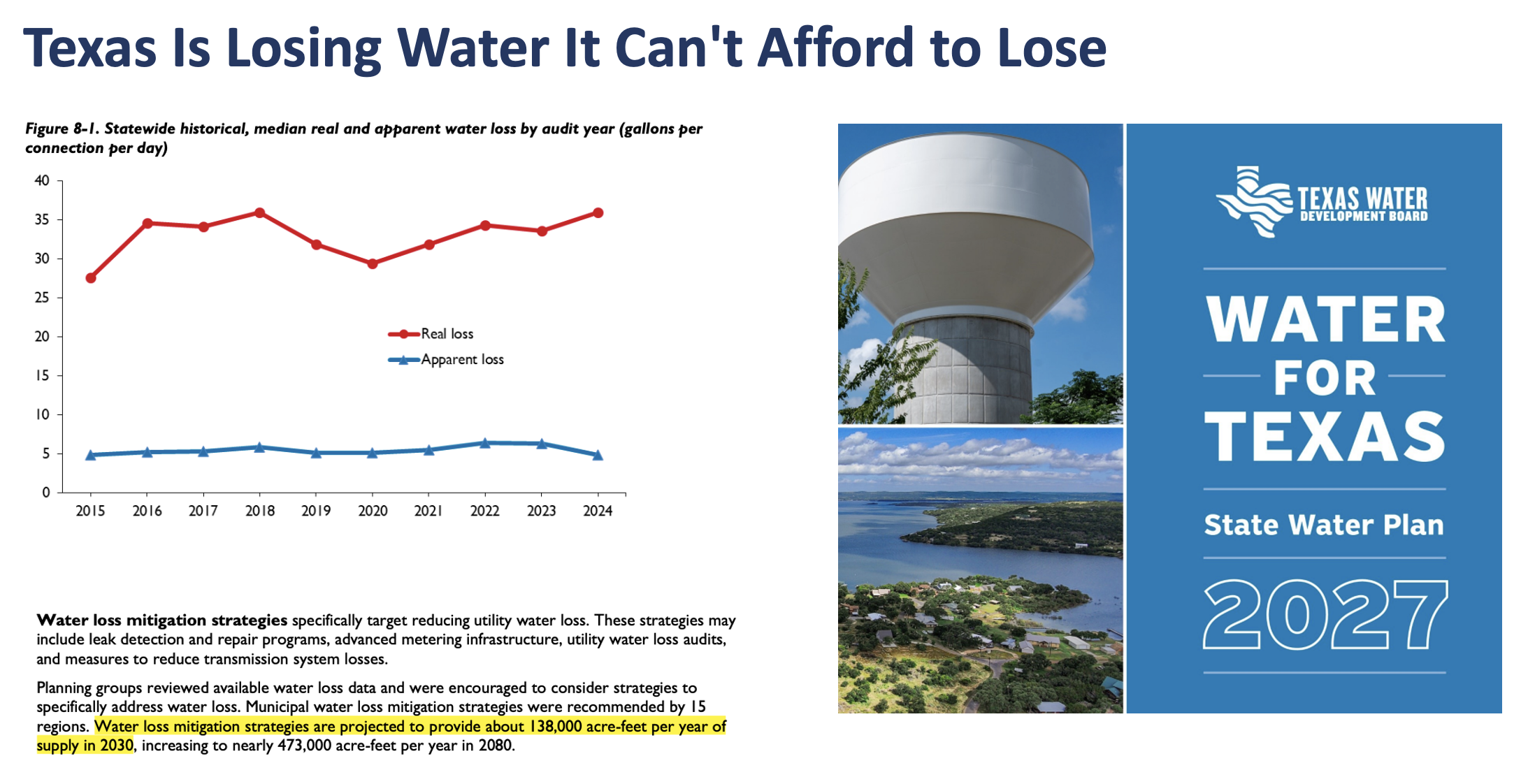
| Audit year | Real loss | Apparent loss |
|---|---|---|
| 2015 | 27.6 | 4.8 |
| 2016 | 34.5 | 5.2 |
| 2017 | 34 | 5.3 |
| 2018 | 35.9 | 5.8 |
| 2019 | 31.8 | 5.2 |
| 2020 | 29.4 | 5.2 |
| 2021 | 31.8 | 5.5 |
| 2022 | 34.2 | 6.4 |
| 2023 | 33.5 | 6.3 |
| 2024 | 35.9 | 4.8 |
Statewide historical, median real and apparent water loss by audit year (gallons per connection per day).
“In 2025, the TWDB reviewed 2024 water loss audits to identify data issues and conducted targeted outreach, prioritizing smaller and rural systems. This initial review found that approximately 30 percent of submitted audits contained at least one significant data issue, ranging from impossible values and abnormal loss indicators to less severe anomalies.”
“$1 billion supplemental appropriation of general revenue to the Texas Water Fund.”
Of the first implementation round, “$90 million for water conservation and water loss projects” — for communities of 10,001–150,000, with 70 percent offered as grant funding. Demand exceeded supply: nearly 70 proposals requesting “more than $607 million.”
Source: TWDB Texas Water Fund
Approved by Texas voters November 4, 2025. It dedicates “the first $1 billion of the net revenue derived from the imposition of the state sales and use tax that exceeds the first $46.5 billion.”
“This provision would go into effect September 1, 2027, and would expire August 31, 2047.”
Required uses include “Water loss mitigation projects” and “Water conservation strategies.”
Source: TWDB Proposition 4 FAQ
TWDB lists these as categorical Water Efficiency projects:
“2.2-3: Replacing existing broken/malfunctioning water meters with: Automatic meter reading systems (AMR)” and “Advanced metering infrastructure (AMI)”
“2.2-5: Conducting water utility audits, leak detection studies, and water use efficiency baseline studies”
“2.2-10: Distribution system leak detection equipment, portable or permanent”
“Affordable, ongoing financial assistance for projects in the state water plan,” including “conservation and reuse.” Enhanced subsidy for utilities serving “a population of 10,000 or less.”
A conservation or water loss project is eligible only if it appears as a recommended water management strategy in the adopted regional and state water plan.
Source: TWDB SWIFT program
Pipeline leaks, service connection failures, tank overflows, and reservoir seepage. These are gallons that leave the system and never reach a customer.
Meter inaccuracy, unauthorized consumption, data handling errors, and billing gaps. The water reaches customers but is not captured in revenue.
Real and apparent losses require different tools. A utility that does not separate them will spend capital on the wrong interventions.
Illustrative utility, AWWA methodology. Apparent losses are unbilled revenue at the retail rate; real losses are valued at production cost.
Note: All components of the water balance are expressed as volumes of water (not to scale) for the period of reference, typically one year. Source: AWWA M36.

Replace inaccurate meters
Fix radio equipment
Fix digital systems
Fix surface leaks
Fix underground leaks
Replace pipeline
Surface Water
Ground Water
Desal
Water Reuse*
*InfraSync does design and implement distributed reuse systems. Submit the contact us form to learn more.
EPA, AWWA and state programs all describe the water audit as the critical first step in any water loss control program.
Real and apparent losses are from different areas in your systems. So spending on leak detection will underperform if most loss is apparent. Metering replacements solve the problem if most loss is real leakage.
The audit framework breaks the losses into each category so you know where to focus.
A good audit quantifies volumes lost by category – customer meter under registration, distribution leaks – and the cost of those losses: treatment, pumping, source water and lost revenue.
Then it ranks interventions – meter replacement, pressure management, leak survey, data validation – by the financial ROI and ease of implementation vs just possible options without data.
Modern water loss programs expect utilities to use standardized methods and often a validation or data-quality score. Doing the audit first produces a defensible report.
This produces a defensible report for regulators, auditors, and board members. Raising rates or getting funding without a clean accounting of water loss can be very difficult.
If you jump straight to solutions you may overspend on the wrong projects and still see high non-revenue water. Then the stakeholders will lose confidence in the whole program.
If you audit first it often uncovers quick wins. Then prioritizes strategies that have the greatest opportunity for a positive cost benefit.
Each system is unique, the water loss audit and assessment determines WHERE the problem is. Then the utility needs to FIX the problem. This includes the interventions below so each utility can match the best path forward to their own systems needs.
A1 - Meter Replacement & Advanced Metering Infrastructure Program
Meters under-register as they age, and every gallon they miss is water you already treated, pumped, and then just under metered. This approach works off your audit's apparent loss volume. It targets the older or large meters first and replaces them with modern meter technology.
A2 - Partial or Representative Sample Meter Testing Program
You don't need to test every meter to know what your fleet is doing. We pull and test a statistically representative sample by size, make, and age, bench-test it against AWWA accuracy standards, and apply the results across the population to produce a defensible accuracy factor for your audit.
A3 - Wholesale and Large Meter Monitoring Program
A handful of large meters move most of your water. A one percent error on a production or wholesale meter may outweigh thousands of residential meters. This approach tests and monitors on a schedule to detect any meter failures early.
A4 - Water Quality Control & Flushing Reduction
Flushing is water that has already been treated and pumped so you want to minimize it. With this approach we monitor chlorine residual, water age, and turbidity across the distribution system so you flush where the water actually needs it.
A5 - Billing System Audits and Sampling
We take a deep dive into your meter and billing records against meter reads and field conditions. This may include inactive accounts still drawing water, unbilled municipal connections, misconfigured rate codes, and data transfer errors.
R1 – Temporary Leak Detection & Repairs
Your audit will determine the total real losses but not where it is. A targeted leak survey is the fastest path to repair. We design a monitoring approach and deploy field testing to pinpoint leaks and either fix them or hand your crews a prioritized repair list.
R2 – Acoustic Leak Sensors & Repairs
A temporary survey tells you where the leaks were on the day you looked. Permanent acoustic sensors sit 24/7 on your pipes and notify you when a small leak happens before it turns into a huge problem.
R3 - Pressure Monitoring and Control Programs
Leakage rises and falls with pressure, and most systems run higher than they need to overnight. We monitor pressure across your zones, find where pressure (energy and water) is being wasted, and implement controls such as pressure zones and reductions to cut background leakage.
R4 - Condition Based Pipeline Replacement Programs
Replacing pipe just by material or age replaces a lot of pipe that still has life left in it. We combine break history, pressure and transient exposure, soil and material data, and consequence of failure into a condition-based ranking, so the pipe you replace is the pipe actually driving your water loss.
R5 - District Metering Areas & Performance Based Pipeline Replacement Programs
Even better than condition based programs are performance based programs. This includes permanent water meters to create districts per AWWA standards (1000 to 3000 connections each) and monitor waterloss on a daily or monthly basis. Then target the worst zones for leak detection and repairs.
We have a standard approach and process we use as analysts and engineers. To provide consistent results for every utility we have developed a custom built software application called InfraSync Ray to focus on water system assessments.
This enables our team (Water Loss Auditors, GISPs, PEs, etc) to do the work to a higher quality and faster. This is not a software subscription or extra cost, but is a cost savings for our work as it allows us to do data quality reviews and results reporting on the same platforms. The software reporting is included at no additional cost during the contract length.

Mark Mathis is a nationally accredited water audit validator who spent his career at the Texas Water Development Board leading the state’s water loss validation team. He authored the Texas Water Loss Manual for Texas Utilities and helped build the standardized methodology Texas utilities still use today. He serves on both the National and Texas AWWA Water Loss Control Committees.
In 2024, the District produced 877 MG of finished water and billed 676 MG, resulting in 22.9% total non-revenue water. This non-revenue water may be due to losses in the pipelines underground (real losses) or from under registration of flow through meters (apparent losses).
This utility moved forward with a full Advanced Metering Infrastructure (AMI) replacement to fix their apparent losses.
This utility had over 30% non revenue water. Based on field meter testing, the estimated apparent losses were 17% and the real water losses 13%.
Because the utility is capacity constrained, they are undr going both a water metering replacement program and a real water loss leak detection and replacement program.
The Water Audit found and fixed a 200,000 gallon a day apparent loss issue during the assessment phase. Only possible because of the InfraSync Ray audit technology of the metering, billing, and physical system together.
They are moving forward with an integrated AMI and Real Water Loss monitoring system to reduce waterloss to under 10%.
Quick assessment to baseline your water utility performance.
We calculate your high level system performance and potential savings and improvements.
This gives you a clear go or no-go decision without risk
Detailed engineering design of our sensors, software, field services, civil infrastructure, and everything else needed for a complete project
This gives you a detailed cost breakdown and control over how much is done and when it gets done.
We bring a combined team of engineers, field techs, and data analysts to deploy and operate the system.
We scale up or down depending on the complexity of your utility and the level of support needed.
The water loss audit, planning, and funding investigation are required to unlock the larger funding sources. Either from the Texas Water Development Board or cost justified rate increases. Many recent utilities have had funding requests and rate increased denied by their boards because of excessive waterloss and no plan to mitigate
TWDB’s states that a Capital Improvement Plan alone does not constitute an asset management plan. A water loss audit and a water conservation plan are separate documents and requirements.
TWDB DWSRF Project Information Form SFY2027 (form DW-007/008, rev. 12/2025).
Water loss audits are due May 1 every year for municipally owned utilities above 3,300 connections and for any retail public utility carrying TWDB financial assistance. Until a complete audit is filed, that utility is ineligible for TWDB water supply funding.
TWDB Proposition 4 FAQ (Sept 2025); TWDB HB 29 FAQ (rev. 6 Feb 2026); 31 TAC §358.6.
Every retail public water supplier with more than 3,300 connections, and any retail supplier carrying a financial obligation to the TWDB is required to files a validated water loss audit every year. All other retail public water suppliers are required file at least once every five years.
Annual audits are due May 1, every year.
Validation is an independent review of a submitted audit against TWDB’s validation guidelines. It must:
1 – Follow TWDB’s validation guidelines
2 – Carried out by someone other than the person who submitted the audit
3 – Performed by someone who has completed water loss audit validation training and is certified to validate.
Real losses are gallons that physically escape the system. This includes leaks on mains, leaks at service connections, and overflows at storage tanks.
Apparent losses are water used by the customer but are not billed. This is typically from older and inaccurate meters but can also include data handling errors.
Real loss above 30 gallons per connection per day (57 for rural-density systems) or excess apparent loss means part of any TWDB award must be spent on water loss mitigation.
Yes. TWDB requires a utility applying for financial assistance to have its most current water loss audit validated prior to consideration of that request.
M36 is AWWA’s manual for water audits and loss control. It defines the standard water balance used to separate real from apparent losses, and the performance indicators built on it. AWWA formally abandoned “unaccounted-for water” in favour of this method.
Partner with Infrasync for innovative, cost-effective water infrastructure solutions. Take the next step today!

Infrasync Technology Services, LLC provides smart water infrastructure solutions, integrating technology and data to help utilities improve efficiency and sustainability.