How One Florida Utility Caught Illegal Wastewater Dumping By Using Digital Infrastructure
Wastewater sensor networks catch illegal dumping 24/7. See how smart sewer monitoring stopped bad actors and saved thousands on treatment costs.
Human behavior hasn’t really changed all that much throughout history. Many people are content to play by the rules and do their part to help others. We work, play, and live together. But not everyone thinks the same. Some think they are the exception to the rule, that because of their situation, the rules don’t really apply. After all, why should they? Rules are for the normal people, not those who can get away with it.
Unfortunately, I’ve seen this all too often in water systems as well. Someone bypasses a meter to get free water for years. Someone else dumps their industrial wastewater into a manhole. Yet another tie’s their houses French drain into the sewer line. Not uncommon at many utilities.
However, this directly impacts us as utilities! For every home that takes advantage of the system, that is another home that has to now pay 2x or 3x to cover their neighbor’s usage. This presents a difficult situation for a utility. How much time do you spend tracking down violators vs how much do you really save as a utility?
Traditional methods—smoke testing, manual inspections, driving around opening manholes—are expensive, time-consuming, and often ineffective. You’re searching for evidence of crimes that happened hours or days ago, with zero hard data about when, where, or how much.
There’s a better way. Wastewater sensor networks are transforming enforcement from reactive guesswork to proactive, data-driven accountability.
The $4,000-Per-Storm Problem
Let’s take the example of wastewater collection systems. On average, to convey, treat, and discharge a thousand gallons takes $1 (just pretend it does; it makes the math easier). If, all of a sudden, a community’s system goes from 10 MGD to 14 MGD during rain events, that places an additional $4,000 per storm event to treat that wastewater.
Where’s that extra water coming from? Inflow and infiltration? Illegal storm drain connections? Industrial dumping?
Traditionally utilities use smoke testing, visual inspections, etc. to find violators.
Without wastewater sensor networks, you’re guessing. With sensors, you know exactly what’s happening and when.
Case Study: Catching the 2 AM Dumper
Imagine this, a small utility in swampy Florida. They have an older system that is always at risk of overflows and capacity issues. Randomly, some nights they get overflows in the collection system lines…other nights it’s just fine.
They had two options:
Option A: Drive around during and after events, open manholes, scratch their heads, and wonder what happened—because they never witnessed the actual discharge.
Option B: Deploy wastewater sensor networks, receive real-time alerts, and know FOR SURE where flows originated.
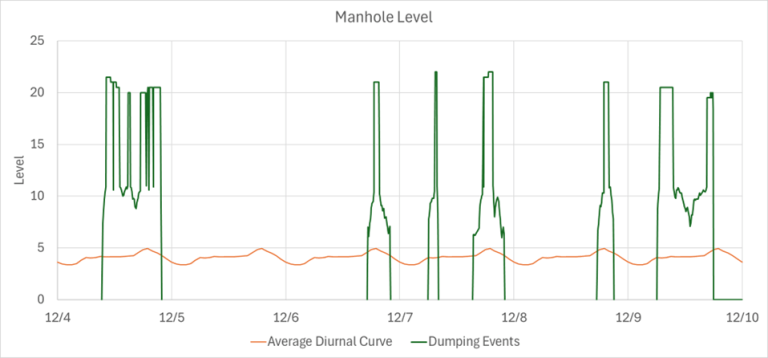
Thankfully this utility chose option B. After a few nights. Ah ha! They found the section with a discharge pattern around 2-4 AM. They coordinated with the local police and performed rolling nighttime inspections, and the flows mysteriously stopped. Whoever was dumping into the system realized they would be caught and stopped.
Scaling Success: From Pilot to Fleet
After this initial success the utility doubled down with 80+ level sensors to track bad actors through the system.
These wastewater sensor networks now provide:
24/7 Bad Actor Detection: Sensors work around the clock, never take vacations, and don’t mind living in wastewater manholes. They catch violations the moment they happen, with timestamps and flow data that hold up as evidence.
Inflow and Infiltration Tracking: Beyond enforcement, the sensor fleet enables precise I&I quantification per sewer shed. Operators can identify which areas contribute excessive stormwater and prioritize rehabilitation investments accordingly.
Predictive Overflow Prevention: Real-time level monitoring combined with AI analytics allows the utility to predict overflow events hours in advance and take preventive action—dispatching crews to clear blockages before sewage reaches streets or waterways.
Cost Recovery and Fair Billing: With hard data on unauthorized discharges, utilities can document violations, enforce compliance, and recover treatment costs. This ensures honest ratepayers aren’t subsidizing bad actors.
Send me a message and I’ll be happy to connect you with this specific utility and the technology teams deploying this;)
Stop Manually Collecting Data
The fundamental shift wastewater sensor networks enable is this: Stop manually gathering data that sensors can collect better, faster, and 24/7.
Move to sensors and software that are more effective at catching the violators. This is going to make the cost-of-service fair and equal across your utility users. Not punishing the law-abiding ones.
The Infrasync Approach: Physical + Digital Infrastructure
At Infrasync, we believe the future of water infrastructure requires combining physical and digital solutions. Wastewater sensor networks exemplify this philosophy, traditional collection systems enhanced with modern monitoring, analytics, and automation.
Our mission is simple: Deliver smart technology solutions that keep water and wastewater systems safe, abundant, and affordable.
Safe: People receive clean water based on the best science and regulatory guidance, with real-time monitoring ensuring quality compliance.
Abundant: People access the water they need without unnecessary restrictions, because utilities can manage systems more efficiently with data-driven insights.
Affordable: People can afford their water bills, because utilities eliminate waste, catch violations, and optimize operations—keeping rates as low as possible while maintaining infrastructure.
Your Next Steps
The bottom line: Manual inspections and smoke testing had their era. Wastewater sensor networks represent the new standard for enforcement, compliance, and system optimization. The question isn’t whether to adopt this technology, it’s how quickly you can deploy it to protect your ratepayers and infrastructure.
Ready to stop midnight dumpers and recover thousands in treatment costs? Visit infrasync.com and submit an inquiry to schedule your initial consultation.
Know someone who could benefit from this approach? Forward this article to them!
Learn More Now - Knowledge is Power, get in touch with a Smart Utility Engineer for an Assessment
Contact us
contact us Get your comprehensive smart utility assessment Physical Infrastructure Performance + Digital Infrastructure Architecture + Performance Benchmarking against industry standards + A strategic roadmap
Smart Utility Webinar – Solving the $780 Billion Water Utilities Crisis
Solving the $780 Billion Water Utilities Crisis Watch this webinar to discover how smart utility technology is transforming water infrastructure management What You Will Learn